Managers are often just as anxious about giving feedback as employees are about receiving it, even when the feedback is positive. But providing constructive feedback is one of a manager's most important responsibilities. Done right, it's a powerful way to improve behavior and performance. Done poorly, it erodes trust and creates confusion.
At the simplest level, the most effective feedback helps both the manager and the employee clearly identify the gap between expectations and output. But it's rarely as clear cut as “good” or “bad.” There's an art to navigating the gray areas of any individual's conduct, actions, and outcomes.
Not All Feedback is Equal
When evaluating feedback, assess where it sits on two scales: negative to positive, and vague to specific. The most effective feedback lives in the upper right quadrant: both positive and specific.
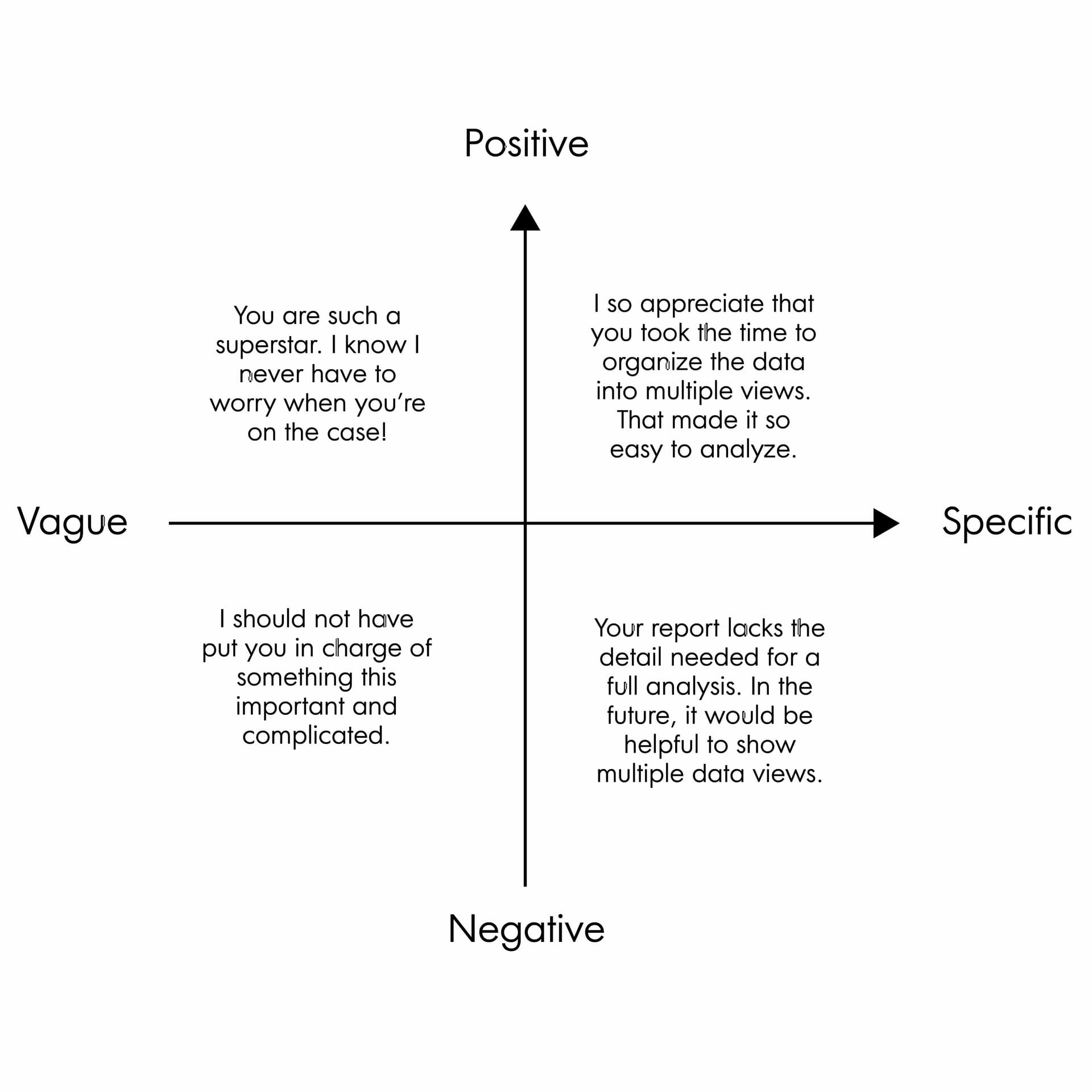
Vague feedback is not very helpful. When it's positive, it may be flattering, but it creates suspicion because the recipient can't take it at face value. When it's negative, it demeans self-esteem and creates confusion because the person doesn't know what specifically went wrong.
Specific feedback, on the other hand, is constructive. Negative feedback that is specific becomes a corrective measure that guides the employee toward a better solution. Positive feedback that is specific inspires the employee to continue performing well and even exceed expectations.
Five Tips for Crafting Effective Feedback
1. Be Specific
Include examples and data to illustrate your feedback. Precision helps the employee understand the situation and helps you avoid an accusatory tone when delivering negative feedback.
Unhelpful: “You've been doing a great job with QA.”
Better: “The extra time you put in to fully document the bugs you found during QA helped the dev team launch three days early.”
2. Be Prescriptive
You're not just reflecting on the past. You're providing instruction for the future. Whether you want someone to change a behavior, take a different approach, or learn a new skill, be clear and direct about expectations.
Unhelpful: “There have been complaints about your project meetings.”
Better: “Your team would benefit from a formal agenda before each meeting and a summary of next steps after.”
3. Be Positive
Even when the feedback is tough, present it in as positive a light as possible. Couch negative feedback in the context of the employee's overall value and potential. A good rule of thumb: include six positive comments for each negative one.
Unhelpful: “You seem to lack initiative when it comes to innovating on procedures.”
Better: “I believe you have some really great ideas on how we can improve procedures, and I'd love to see you bring more of them to the table.”
4. Tell the Whole Story
Don't assume employees understand the broader impact of their work. Explain why what they do matters and how different levels of performance affect efficiency, profitability, and the team. Help them see they're part of a larger vision.
Unhelpful: “Your quarterly reports have been really helpful.”
Better: “Your quarterly reports have been really helpful because the way you broke information down by company size gave the sales team great insights into tailoring their pitches.”
5. Be Professional
Always be respectful and objective. This helps prevent the employee from feeling like comments are personal, which will send a feedback conversation off the rails.
Four Elements of a Great Feedback Experience
When
Don't wait for the annual review. Get in the habit of providing feedback more frequently: when an employee reaches a goal, learns a new skill, completes a project, or during monthly and quarterly check-ins. The point is not to put off giving feedback and not to feel like you have to wait all year to let your team know how they're doing.
How
- Avoid surprises. Establish an ongoing dialog so both you and your employee know which topics will be on the table when you sit down.
- Listen first. Let your employee speak first. Each of us is usually our harshest critic. Hearing their perspective first will help you calibrate your delivery.
- Invite collaboration. Position the conversation as an opportunity for the two of you to work on solving challenges together, not a platform for you to deliver judgment.
Where
Positive feedback can be shared publicly when appropriate, but be aware of how praising one person may affect others. Negative feedback should always be delivered privately. These conversations are tough enough without an audience.
With What Intention
Good or bad, the point of all feedback is to help someone do a better job in the future. Take a future-focused approach by connecting feedback to new goals. Even negative comments represent opportunities for growth. Use them as a starting point for where the employee wants to go next.
The SMART goal-setting framework helps here:
- S Specific
- M Measurable
- A Achievable
- R Results-Oriented
- T Time-bound
When Things Go Wrong
Sometimes despite your best preparation, the conversation goes sideways. Here's how to handle it:
- Be prepared. Have all the relevant facts at hand so your feedback doesn't come off as a personal attack. If there's a personnel issue, do your homework and talk to everyone involved first.
- Listen. Don't fall into the trap of hearing what you expect to hear. Keep an open mind so you can get an accurate read on what the other person is saying.
- Be empathetic. Even the most professional employee has emotions. Consider personality, learning style, and what else is going on in their life that may influence their response.
- Keep your cool. Don't get pulled into responding emotionally. If the conversation gets too heated or reaches an impasse, it's okay to table the discussion.
The Coaching Mindset
Ultimately, providing feedback is less about passing judgment and more about helping the people you lead uncover opportunities to improve. Think of yourself as a coach, not an evaluator. You're not handing out gold stars and black marks from on high. You're working in partnership with your employee to reach a shared goal.
The next time you need to provide feedback, look at it as a chance to mentor someone. Remember that you and your employee are on the same team, and you both want the same thing: to do the best work possible so that everyone wins.
Adapted from “How to Give Effective Performance Feedback” by Liz Cain at OpenView Partners. Presented with credit for educational use.